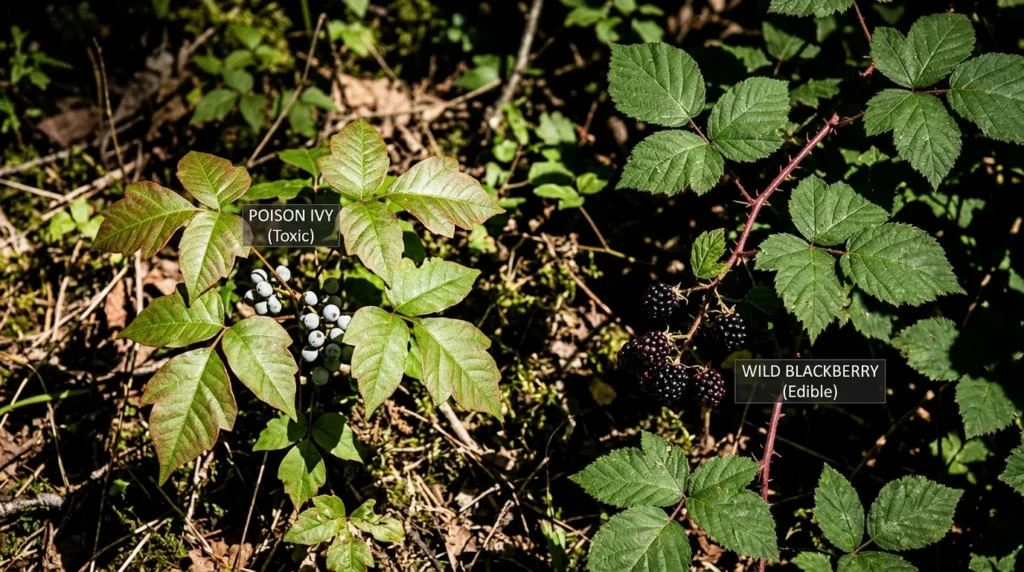
You reach into the hedge for a blackberry, and something in the back of your mind asks whether that cluster of three leaves belongs to the fruit or to the plant you have been avoiding since childhood. Both grow in the same untidy places. Both climb. Both throw out leaves in threes. And at arm’s length, in low evening light, they can look close enough that people stop and second-guess themselves.
There is one difference that settles it faster than anything else, and it is worth knowing before you are standing in front of the plant.
Check the stem: poison ivy has no thorns on it, ever
That is the whole test, and it works in both directions.
Wild blackberry is a bramble. It is armed — thorns run along the canes, and on many plants they continue onto the leaf stalks and the undersides of the leaves themselves. Run a finger along the stem and you will find them, or you will find them by accident, which is how most people learn.
Poison ivy has none. It has no thorns on the stem, none on the vine, none on the branches — no prickles and no spikes anywhere on the plant. If what you are looking at has thorns, it is not poison ivy.
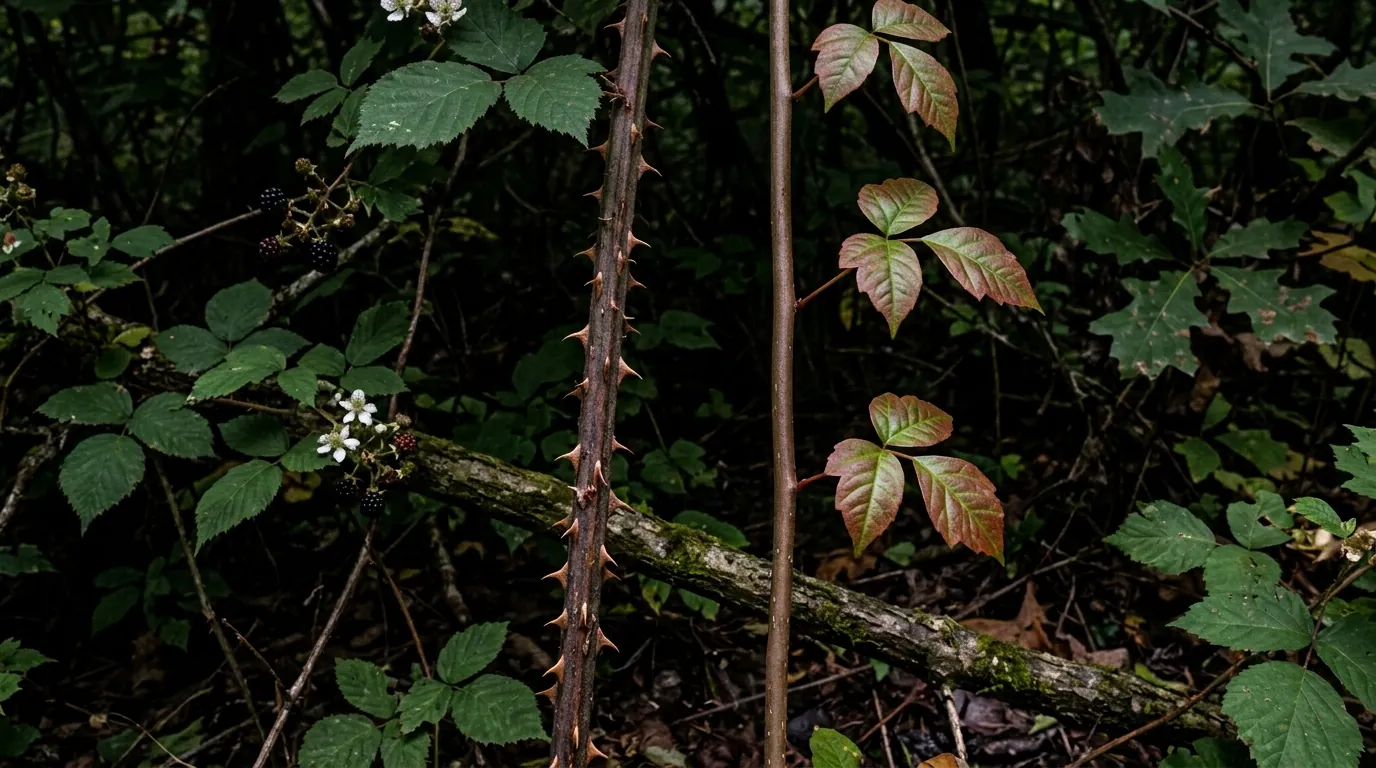
People ask whether poison ivy can have thorns, usually because they have found a three-leaflet plant that does. The answer is no. What they have found is a bramble, or a different plant entirely. The same holds for poison oak, which is a close relative and is also unarmed.
This is the rare identification rule that holds up. It does not depend on the season, the light, or how the leaves happen to have grown on that particular plant.
Botanically the sharp parts on a blackberry are prickles rather than true thorns, which is a distinction worth exactly nothing when your hand is already in the hedge. Sharp is sharp, and poison ivy has none of it.
The leaf-edge rule most articles repeat is not reliable
Search for this comparison and you will be told, over and over, that blackberry leaves have jagged edges while poison ivy leaves are smooth. Half of that is true. The other half is the part that can get you.
Extension sources describe poison ivy leaflets as having margins that may be smooth, toothed, or lobed — and note that the leaves vary widely in shape and appearance, sometimes on the same plant. A poison ivy leaflet with a toothed edge is not unusual. It is normal.
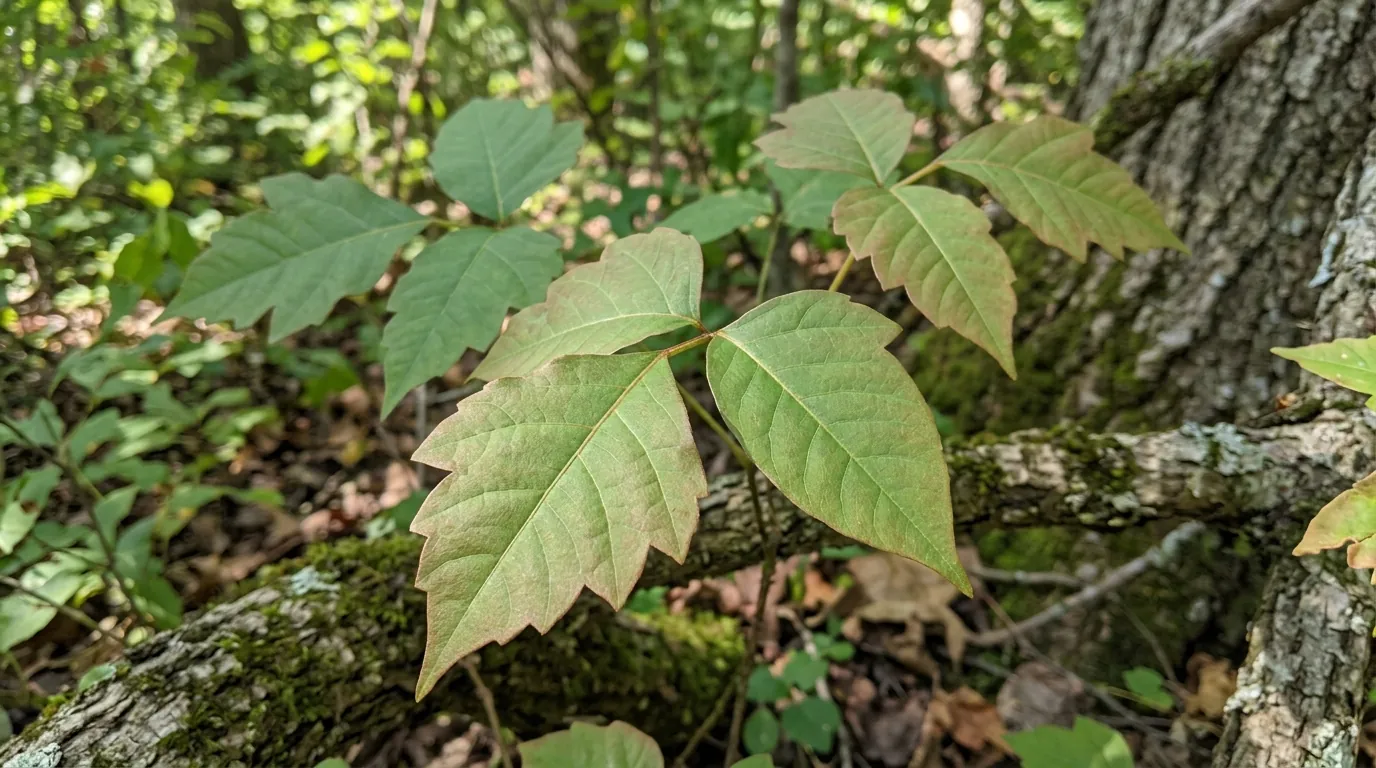
So if you check the edges, find them jagged, and conclude you are looking at blackberry, you have used a rule that does not carry the weight people put on it. Check the stem for thorns instead. That answer does not change from plant to plant.
Flowers are the other shortcut that fails. People look for white flowers as the friendly sign, but poison ivy flowers too — small, yellowish-green, easy to overlook, and often described as tiny and white. Blackberry flowers are unmistakable by comparison: five broad petals, white or pink, roughly an inch across. It is the size and the shape that separate them, not the colour. And if the plant is flowering, the stem is right there anyway.
When there is no fruit and no clear stem
Late in the season the fruit decides it for you: blackberries are large, dark, and obviously edible-looking, while poison ivy carries small, pale, waxy berries in loose clusters near the stem. Nobody confuses those two once both are ripe.
The harder case is early growth, or a plant climbing a trunk with the stem out of easy reach. Here the useful detail is what poison ivy uses to climb. It anchors itself with short aerial roots along the stem, which give a mature vine a distinctly hairy, fuzzy appearance against the bark. A blackberry cane does not do this. It leans, arches, and sprawls, held up by its own stiffness and its thorns.
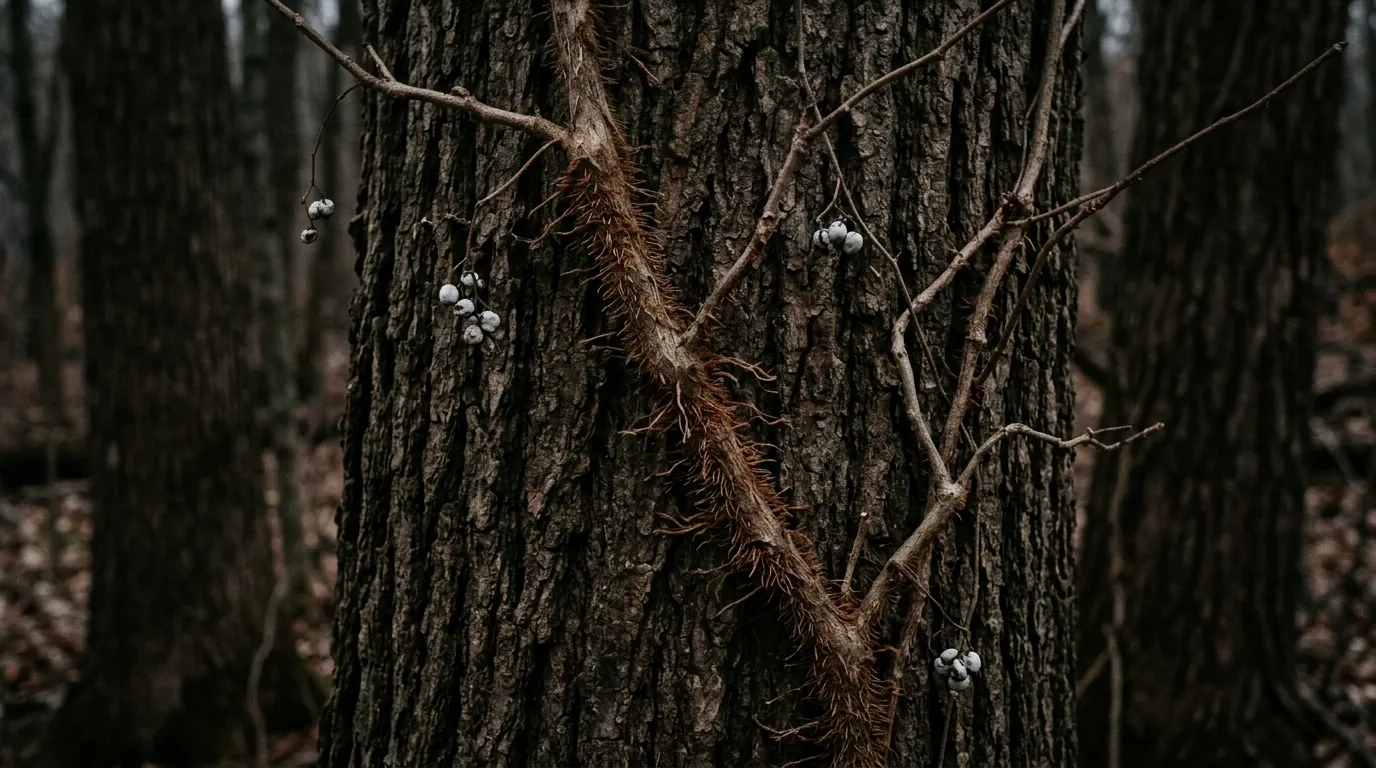
A hairy-looking rope up a tree trunk is worth treating as poison ivy until something proves otherwise, including in winter when there are no leaves at all to argue about.
Climbing habit is doing the same work in another pair worth knowing: wild grape vine and moonseed are told apart by how the vine holds on and how the fruit is arranged, not by the colour of the berries.
What to do if you have already touched it
The reaction to poison ivy comes from urushiol, an oil that stays on skin, clothing, tools and pet fur until it is removed. That is why people sometimes react a second time days later, having washed themselves but not the gloves.
If you think you have brushed against it, the general advice from health and extension sources is to wash the skin thoroughly with soap and water as soon as you reasonably can, and to wash anything else the plant touched separately. Anything beyond that — how a reaction should be treated, or when it needs attention — is a question for a medical professional, not for a plant article.
Practical takeaway
Look for thorns first. Blackberry has them; poison ivy never does, and that single check is more reliable than the leaf-edge rule that fills the search results. If the stem is out of reach, look at how the plant climbs: hairy aerial roots against bark mean treat it as poison ivy.
And if the answer is still unclear, the correct move is the boring one. Leave it. A blackberry you did not pick costs you nothing.
The rest of the backyard lookalikes notes work the same way: one familiar plant, one that deserves more caution, and the detail that separates them.
Keep exploring the same topic
Get the notes
One practical email when a new story is worth your time.
Short field notes, kitchen flags, and backyard context without spam or wellness fluff.
Key reminder
Use the risk badge and context together. A familiar look, label, or assumption is never enough to treat a finding as safe.